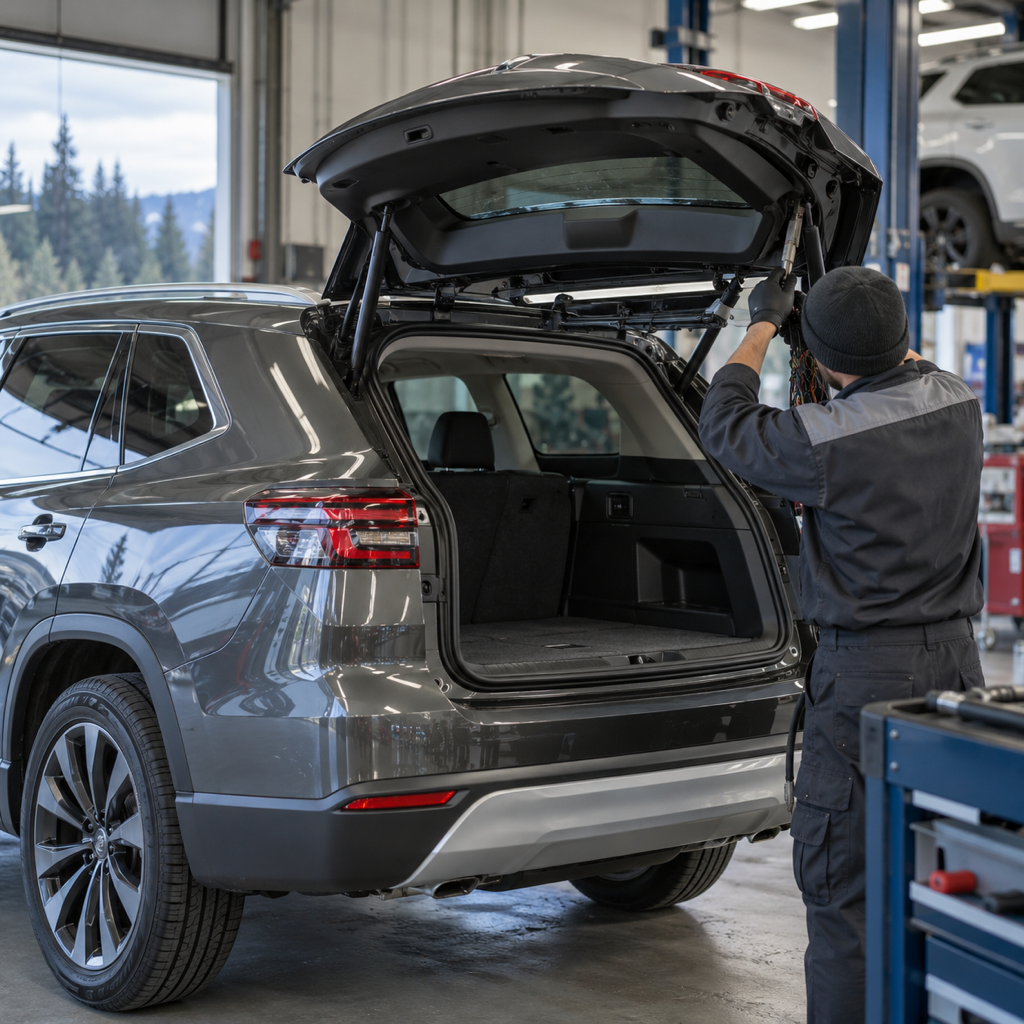
A rear-end collision can leave a vehicle looking surprisingly normal from the outside. The bumper may have been repaired, the tailgate may appear to close, and the vehicle may seem ready to return to everyday driving. But on modern vehicles, the rear of the vehicle contains much more than body panels and a latch.
Many SUVs, crossovers, and newer passenger vehicles are equipped with power liftgates that use electric motors, control modules, switches, sensors, wiring, latches, and position mechanisms. These components can be affected by a collision even when the visible damage appears relatively minor.
If your power liftgate begins behaving differently after an accident, it should not simply be treated as an inconvenience. Changes in operation can provide useful information about damage behind or around the rear body panels.
For vehicle owners in Vancouver, WA, understanding why this happens can help prevent a small electrical or mechanical issue from being overlooked during collision repair.
What Is a Power Liftgate?
A power liftgate is an electrically operated rear hatch system. Instead of requiring the driver to manually lift the hatch, the system uses an electric motor or powered struts to open and close it.
Depending on the vehicle, the system may be operated through:
- A button on the liftgate
- A dashboard switch
- A key fob
- A button near the driver
- A hands-free sensor beneath the rear bumper
- Automatic locking and closing functions
Because several components work together, damage to one part of the system can change how the liftgate behaves.
Why Rear-End Collisions Can Affect the Liftgate
The liftgate itself is only one part of the rear structure. Around it are hinges, latches, wiring harnesses, sensors, trim pieces, brackets, and electrical connections.
A collision can transfer force into these areas.
Even when the exterior panel has only a small dent, the impact may cause a component to move slightly, a connector to become loose, or wiring to be stretched or damaged.
This is one reason a proper collision inspection needs to go beyond visible body damage.
Signs Your Power Liftgate May Need Inspection
One of the most obvious warning signs is a change in opening or closing behavior.
The liftgate may:
- Open more slowly than before
- Stop partway through its movement
- Require multiple attempts to operate
- Make an unfamiliar motor sound
- Close but fail to latch correctly
- Reverse direction unexpectedly
- Operate from one switch but not another
- Work intermittently
- Stop responding altogether
A vehicle owner may assume the problem is simply a dead battery in the key fob or a temporary electrical issue. Sometimes that may be the explanation, but if the problem appeared immediately after a collision, the timing deserves attention.
The Importance of the Liftgate Latch
The latch plays an important role in keeping the liftgate secured.
After a rear-end collision, technicians may inspect the latch area for signs of impact, movement, or damage. If the latch position has changed, the liftgate may not close or lock as it did before the accident.
This can also create secondary symptoms.
For example, the vehicle may repeatedly indicate that the rear hatch is open even though it appears closed. Depending on the vehicle, this can affect warning messages, interior lighting, alarm behavior, or other vehicle functions.
The exact symptoms vary by manufacturer and model.
Hinges and Powered Liftgate Mechanisms
The liftgate depends on mechanical components to move through its intended range.
A collision can place unusual force on the hinges or powered lifting mechanism. Even a relatively small change in position may affect how the hatch moves.
A technician may therefore inspect:
- Liftgate hinges
- Powered struts or drive mechanisms
- Mounting points
- Latch alignment
- Fasteners
- Brackets
- Electrical connections
The objective is not simply to make the hatch move again. The system should be evaluated as a complete mechanism.
Wiring Can Be Part of the Problem
Modern liftgates often contain electrical components within the rear hatch itself.
Wiring may run through areas where the hatch connects with the vehicle body. During a collision, wiring can potentially be stretched, pinched, disconnected, or damaged.
Electrical damage can be particularly frustrating because the system may work intermittently.
For example, a liftgate might open normally several times and then fail without warning. That type of intermittent behavior can make the problem difficult to identify without a systematic inspection.
Why a Working Liftgate Does Not Always Mean Everything Is Fine
A common assumption after a collision is:
“If it opens and closes, it must be okay.”
That is not necessarily enough.
A component can sustain damage without immediately failing. A connector can remain partially connected. A bracket can be slightly displaced. A wiring harness can be damaged without producing an immediate complete failure.
For that reason, collision repair should consider both current operation and evidence of impact around the system.
Power Liftgates and Vehicle Electronics
Modern vehicles are highly integrated.
A liftgate system may communicate with other vehicle electronics, depending on the vehicle's design. Collision-related electrical problems can therefore sometimes produce warning messages or unusual behavior elsewhere.
This does not mean every liftgate problem indicates a larger electrical failure. It means the system should be diagnosed according to the vehicle manufacturer's repair information and the actual symptoms present.
Why DIY Adjustments Can Create More Problems
It can be tempting to force a liftgate into position, adjust components yourself, or repeatedly operate a malfunctioning powered system.
That may not address the underlying cause.
If the issue is related to collision damage, determining whether the problem is mechanical, electrical, or related to alignment is more useful than simply forcing the component to operate.
A professional collision repair facility can inspect the affected area and determine what needs attention.
What Motolux Collision Center Looks For
At Motolux Collision Center in Vancouver, WA, rear-end collision repair involves looking beyond the most obvious exterior damage.
When a vehicle is equipped with a power liftgate, its operation can be part of the post-collision inspection. Depending on the vehicle and damage, technicians may evaluate the liftgate's movement, latch operation, electrical connections, mounting areas, and related components.
The exact inspection process depends on the vehicle's construction and the nature of the collision.
A Small Symptom Can Provide an Important Clue
If your power liftgate behaved perfectly before an accident and began acting differently afterward, that change is worth reporting to your collision repair shop.
Tell the technician exactly what changed.
For example:
- “It takes longer to open.”
- “It stops halfway.”
- “The button works intermittently.”
- “It closes but doesn't seem to latch normally.”
- “The dashboard says the hatch is open.”
- “The liftgate makes a different sound.”
Specific observations can help technicians understand when and how the problem occurs.
Collision Repair Is About More Than Appearance
Modern collision repair requires attention to mechanical and electrical systems as well as exterior panels.
A vehicle can look repaired while still having an unresolved functional problem. Power liftgate behavior is one example of how a relatively small symptom can point technicians toward an area that deserves additional inspection.
If your vehicle was involved in a rear-end collision and the power liftgate is no longer operating normally, having the system evaluated can help identify whether the change is related to the accident.
For drivers looking for collision repair in Vancouver, WA, Motolux Collision Center provides vehicle damage inspection and repair services with attention to both visible and functional issues.