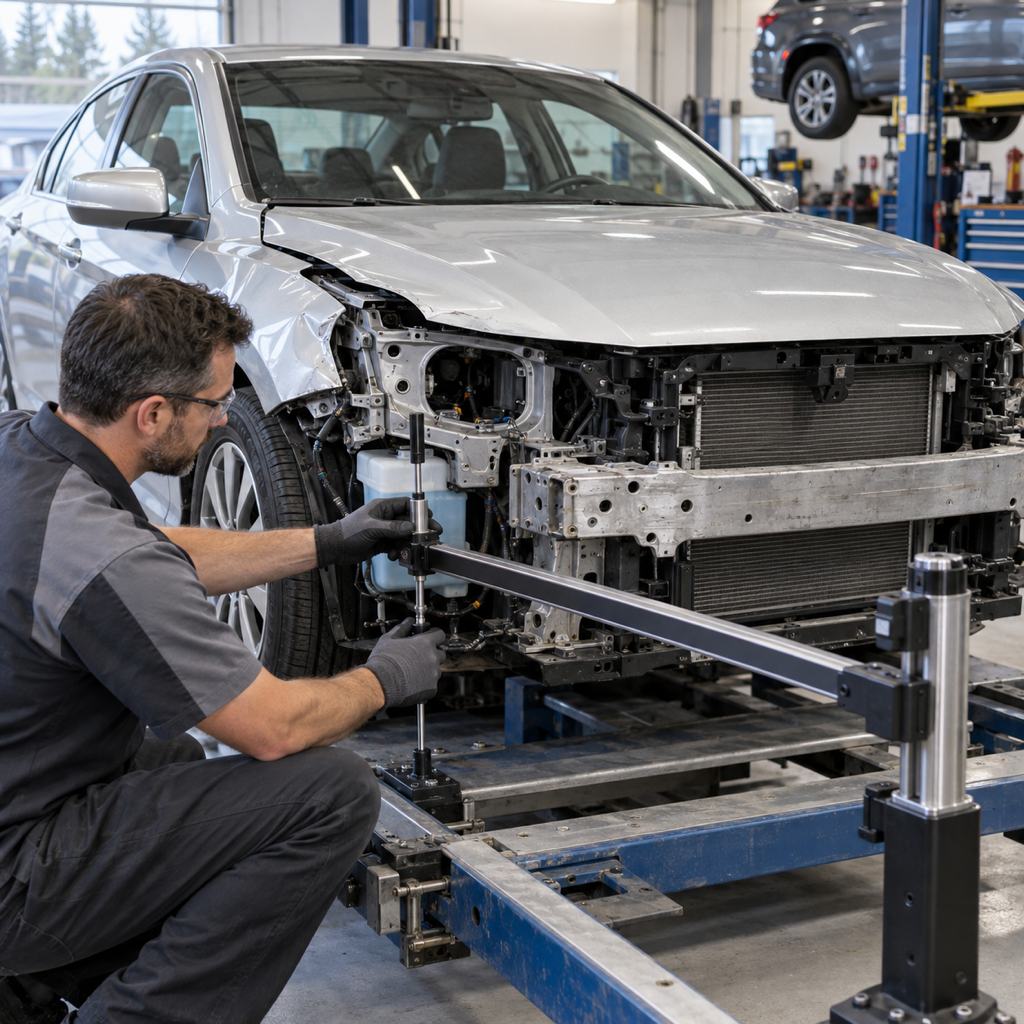
A Vancouver, WA customer brought their sedan to Motolux Collision Center following a front-end collision at an intersection.
The accident occurred when another vehicle struck the driver's vehicle near the front corner.
From the outside, the damage appeared manageable.
The bumper was damaged, one fender had a visible dent, and the grille had been pushed slightly out of position.
The customer reported that the vehicle was still running and could be driven.
Based on the visible damage alone, it would have been easy to assume the repair was primarily cosmetic.
The Initial Inspection
Motolux technicians began with a comprehensive inspection of the vehicle's front end.
The bumper and exterior panels were examined first, but the team continued beyond the visible damage.
The front structure and relevant mounting points were inspected to determine whether the collision had transferred force deeper into the vehicle.
The uneven positioning of the grille and bumper suggested that the impact may have affected the components behind them.
Measuring the Vehicle Structure
The vehicle was evaluated using appropriate structural measuring procedures.
Measurements revealed that one section of the front structural assembly was no longer positioned within the vehicle's required dimensions.
The deviation was not dramatic enough to be obvious from outside the vehicle.
However, it was significant enough to require correction before the exterior repair could be considered complete.
Why This Finding Mattered
The affected structural area was connected to the positioning of several front-end components.
If the structural issue had been ignored and only the bumper and fender were repaired, the vehicle could have developed additional fitment and alignment concerns.
The bumper might not have maintained the correct position.
The grille could have remained uneven.
Other components attached to the front structure could also have been affected.
Most importantly, the vehicle's structure needed to be restored properly rather than simply covered with replacement body panels.
The Structural Repair
Technicians developed a repair plan based on the vehicle's condition and applicable repair procedures.
The affected structural area was carefully restored using appropriate equipment and measurements.
Measurements were repeated throughout the process to confirm that the structure was returning to the required dimensions.
This step was particularly important because structural repair is based on accuracy rather than appearance.
Exterior Repairs
Once the structural work was completed, technicians addressed the visible collision damage.
The damaged bumper and fender were repaired or replaced as appropriate, and the grille was properly positioned.
Panel gaps and mounting points were checked to ensure the exterior components fitted correctly around the restored structure.
Refinishing and Final Assembly
The affected exterior areas were then prepared and refinished to achieve a consistent appearance with the rest of the vehicle.
Technicians carefully reassembled the front-end components and checked that all parts were securely mounted.
The goal was to ensure that the finished vehicle looked natural rather than showing signs of uneven fitment.
Final Quality Inspection
Before returning the vehicle to the customer, the team performed a final inspection.
The vehicle was evaluated for:
- Structural measurements
- Panel alignment
- Bumper fitment
- Grille positioning
- Hood operation
- Lighting
- Steering and handling
- Overall exterior finish
A road evaluation was also completed to verify that the vehicle behaved normally after the repair.
The Result
The customer received a vehicle that looked significantly different from its post-accident condition.
More importantly, the repair had addressed the hidden structural issue rather than simply repairing the visible body damage.
The customer was surprised to learn that the collision had affected an area that could not be seen without removing or examining components around the front end.
What This Case Demonstrates
This case illustrates why a collision should never be judged solely by how much damage is visible.
A damaged bumper and fender may represent only the outermost portion of the impact.
Structural components underneath can absorb and transfer collision energy without showing obvious external signs.
A detailed inspection allows technicians to identify these issues and determine what needs to be restored.
Key Takeaway
The visible damage after an accident is not always the complete damage.
Professional collision repair combines inspection, structural measurements, body repair, refinishing, and final testing to restore the vehicle as completely as possible.
For drivers in Vancouver, WA, having a vehicle thoroughly evaluated after a collision can help uncover hidden structural problems before they become larger repair concerns.