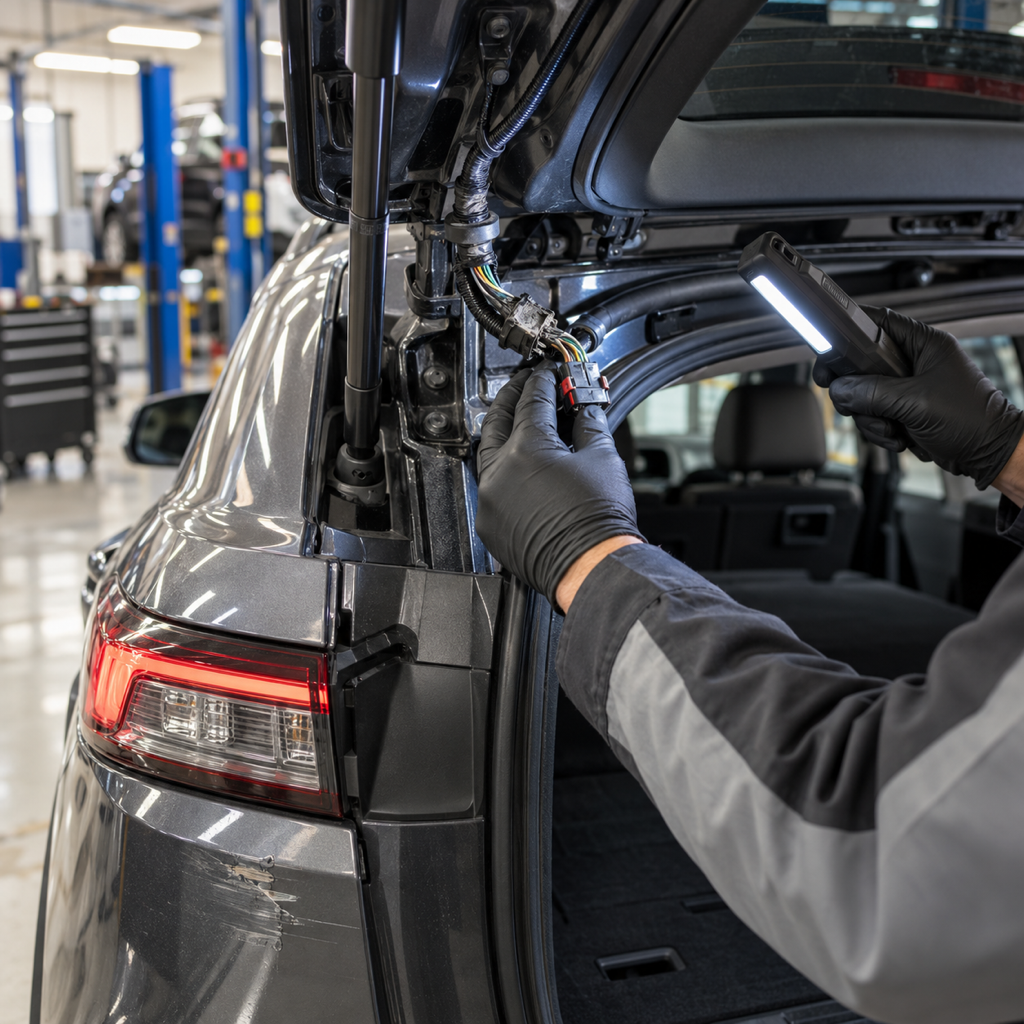
Case Study Type: Representative Collision Repair Scenario Location: Vancouver, WA Vehicle: Modern SUV with a power liftgate Primary Concern: Power liftgate operating intermittently after a rear-end collision
The Situation
A customer brought a modern SUV to Motolux Collision Center in Vancouver, WA after a low-speed rear-end collision.
At first glance, the damage appeared relatively limited.
The rear bumper had visible impact marks, and there was some damage around the rear hatch area. The customer was primarily concerned about the exterior appearance and whether the bumper and liftgate could be repaired.
However, the customer also mentioned something that initially seemed minor: the power liftgate had started behaving inconsistently after the accident.
Sometimes it opened normally.
Other times, it would stop during operation or fail to respond to the switch.
Before the collision, the power liftgate had been operating normally.
That timing made the symptom relevant to the collision inspection.
Initial Inspection
The vehicle was inspected to understand the visible damage and determine whether any related components had also been affected.
The rear bumper area was examined first, followed by the liftgate, latch area, hinges, mounting points, and surrounding body panels.
The liftgate itself did not appear severely damaged.
It could open and close, which initially made the problem less obvious.
However, the inconsistent operation indicated that further investigation was appropriate.
A collision repair inspection should not rely only on whether a component works once during a brief demonstration.
Intermittent problems can be especially important because they may indicate a loose connection, damaged wiring, displaced component, or another issue that does not produce a complete failure every time.
The Liftgate Symptom
During repeated operation, the liftgate showed inconsistent behavior.
On some attempts, it responded normally.
On others, the system hesitated before operating.
The technician documented the behavior and continued inspecting the components around the rear hatch.
The purpose was not to assume that the wiring was damaged, but to identify what could explain the change in operation following the collision.
Looking Beyond the Exterior Panel
The visible rear body damage did not tell the entire story.
The inspection continued into the areas where the liftgate's electrical connections and related components were located.
The technician checked the wiring routing and connections associated with the liftgate system.
During the inspection, evidence of stress around a wiring connection was identified.
The wiring had not been completely severed. Instead, the collision had affected the connection enough to create intermittent operation.
This helped explain why the liftgate could work normally during one test and behave differently during another.
Why the Problem Was Easy to Miss
The vehicle owner could still operate the liftgate.
There was no complete electrical failure.
The exterior damage was also more visually obvious than the wiring issue.
If the inspection had stopped after confirming that the liftgate opened and closed once, the intermittent issue could potentially have been overlooked.
This is an important lesson in collision repair.
A system that technically operates is not necessarily a system that has been fully evaluated after an impact.
Repair Assessment
Once the affected area was identified, the repair process could be planned around the documented damage.
The technicians evaluated the wiring connection and surrounding components to determine the appropriate repair according to the vehicle's requirements.
The rear exterior damage was addressed separately as part of the collision repair process.
The goal was to address both the visible body damage and the functional concern reported by the customer.
Functional Testing
After the necessary repair work, the power liftgate was tested repeatedly.
Testing included checking the system through its normal operating controls and observing whether the previous intermittent behavior returned.
The liftgate was also evaluated for proper closing and latching behavior.
Repeated testing was important because the original complaint was intermittent.
A single successful opening would not have provided the same level of confidence as repeated operation.
Why Customer Observations Matter
One of the most useful pieces of information in this case was the customer's description of what had changed.
The customer did not simply say:
“The liftgate is broken.”
Instead, the customer explained that:
- The liftgate worked normally before the accident.
- The issue started after the collision.
- The system worked sometimes.
- It behaved differently on different attempts.
That information helped direct attention toward a collision-related functional issue rather than treating the problem as an unrelated vehicle malfunction.
What This Case Demonstrates
This representative case illustrates why collision inspections need to consider both appearance and function.
A rear-end collision does not only affect the bumper cover.
Depending on the vehicle and impact, technicians may need to inspect:
- Liftgate mechanisms
- Latches
- Hinges
- Wiring
- Electrical connectors
- Mounting points
- Sensors
- Rear body components
The exact inspection depends on the vehicle and collision.
Why Intermittent Problems Deserve Attention
Intermittent electrical problems can be difficult for vehicle owners to diagnose because the system may appear normal at one moment and fail at another.
That can lead to the assumption that the issue has disappeared.
In a collision repair situation, however, a newly developed intermittent problem should be documented and investigated.
The repair facility can then determine whether there is physical evidence connecting the symptom to the accident.
The Difference Between Cosmetic and Functional Repair
A vehicle's exterior appearance is obviously important after a collision.
But modern vehicles contain many systems that are not visible from outside.
A repair that addresses only the visible bumper damage would not fully address a customer's concern if the power liftgate continued to malfunction.
This is why communication between the customer and repair facility is important.
Small changes in vehicle behavior can provide valuable clues.
The Outcome
After the affected liftgate wiring connection and associated collision damage were addressed, the system was tested repeatedly.
The previous intermittent behavior was no longer observed during the repair facility's testing.
The exterior repair was also completed as part of the collision repair process.
The customer was informed about the functional issue that had been identified during the inspection and the work performed to address it.
Key Takeaway for Vancouver, WA Drivers
If a vehicle develops a new electrical or mechanical symptom immediately after an accident, mention it to the collision repair facility even if the vehicle still appears to function normally.
A power liftgate that hesitates, stops, behaves inconsistently, or responds differently after a rear-end collision may provide an important clue about damage that is not immediately visible.
For drivers in Vancouver, WA, Motolux Collision Center can assess collision-related body and functional concerns as part of the repair process.
The most useful information you can provide is often simple: explain exactly what the vehicle did before the accident and what changed afterward.