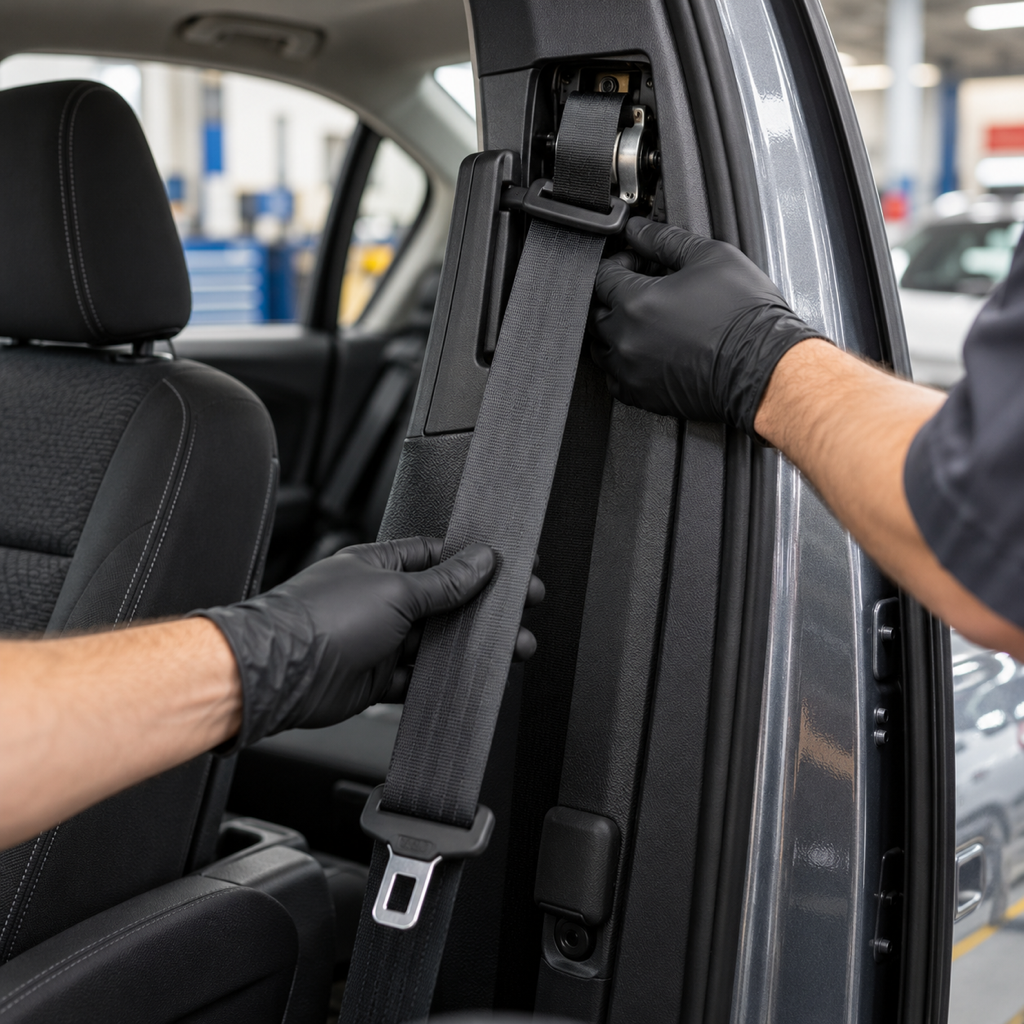
Case Study Type: Representative Collision Repair Scenario Location: Vancouver, Washington Vehicle: Modern passenger vehicle Primary Concern: Seat belt not retracting normally after a collision
Editorial note: This is an illustrative case study based on a plausible collision-repair scenario. It is not a verified Motolux customer record. Before publishing it as an actual customer case, replace the scenario details and outcome with documented information from a real repair.
The Situation
A vehicle owner sought an inspection after a collision that caused visible damage to the vehicle's exterior.
The primary concern was the body damage. The owner wanted the affected panels evaluated and wanted to understand what repairs would be necessary.
During the initial discussion, the owner also reported a change inside the vehicle: one seat belt did not retract as smoothly as it had before the accident.
The belt still extended and could be fastened, but it appeared to move differently when released.
Because the symptom began after the collision, it was included in the inspection rather than being treated as an unrelated inconvenience.
Why the Seat Belt Concern Was Important
A seat belt is a safety-related component.
Its condition cannot be determined solely by checking whether the webbing is present or whether the buckle clicks into place.
The belt assembly may include a retractor and, depending on the vehicle, a pretensioner and associated electrical components.
If any of these parts have been affected by a collision, the correct response depends on the vehicle manufacturer's inspection and replacement requirements.
For this reason, the reported change warranted a closer evaluation.
Initial Inspection
The inspection began with documenting the collision damage and recording the owner's concern.
The seat belt webbing was visually examined for obvious cuts, fraying, contamination, or other visible damage.
The buckle and belt movement were also considered as part of the initial assessment.
However, the inspection did not stop at appearance.
A belt that looks intact may still require additional evaluation if its retraction behavior has changed or if the collision may have activated a restraint component.
Investigating the Retraction Problem
The retractor is responsible for managing the extension and return of the belt webbing.
When a belt no longer retracts normally, there may be several possible explanations.
The issue could involve the retractor mechanism, belt routing, contamination, an obstruction, damage to associated components, or another condition.
A collision-related concern must be evaluated using the procedures appropriate for that specific vehicle.
The purpose of the inspection is to establish whether the component is serviceable or whether manufacturer-directed replacement is required.
Why a Simple Pull Test Is Not Enough
A seat belt that extends and retracts once does not automatically pass a complete post-collision assessment.
The system may have specific inspection requirements following certain collision events, particularly when pretensioners or other restraint components may have activated.
Depending on the vehicle, technicians may need to review diagnostic information, inspect mounting points, check related components, or follow specified replacement criteria.
The system should not be declared safe solely because the webbing appears normal.
Considering the Vehicle's Restraint System
Seat belts are part of a larger occupant restraint system.
Depending on the vehicle, this may include pretensioners, load limiters, buckle switches, occupant sensors, airbags, and electronic control components.
The collision circumstances can influence which components require inspection.
If restraint-system warning lights were present or any restraint components activated, that information would be important when determining the next steps.
In this representative scenario, the seat belt retraction concern was treated as a separate item requiring an appropriate safety-focused assessment.
Following Manufacturer-Specific Procedures
Seat belt and restraint-system requirements vary by manufacturer and vehicle model.
Some components may be required to be replaced after specific collision events. Others may be subject to defined inspection criteria.
Technicians must follow the applicable repair information rather than assuming that every seat belt can be repaired in the same way.
Restraint components should not be dismantled, modified, or repaired without the required training and procedures.
If a repair facility does not have the equipment or expertise needed for a particular restraint-system issue, specialist diagnosis may be necessary.
Determining the Appropriate Repair
After the concern was documented, the next step in the representative scenario was to determine the condition of the affected seat belt assembly and identify the applicable manufacturer requirements.
The repair decision would depend on the findings.
If the retractor or another restraint component failed the required inspection criteria, the appropriate replacement procedure would need to be followed.
If the issue had another cause, that cause would need to be addressed without bypassing any required safety checks.
The objective is not simply to make the belt move more smoothly. It is to ensure that the restraint system meets the applicable service requirements.
Why the Owner's Description Helped
The owner provided three useful details:
- The belt had worked normally before the accident.
- The retraction behavior changed afterward.
- The issue was noticeable during normal use.
These observations helped identify a specific concern for the inspection.
Customers do not need to diagnose the problem themselves. They simply need to describe what changed.
This is particularly helpful when a symptom is intermittent or difficult to reproduce during a brief visit.
Post-Repair Verification
In a real repair, verification would depend on the work performed and the manufacturer's requirements.
Where a seat belt assembly or associated restraint component is replaced, the repair facility would need to confirm that the work was completed correctly and that any required diagnostic or system checks were performed.
If diagnostic trouble codes were present, the appropriate procedure would need to be followed to determine their cause and confirm the required repair.
A warning light should not simply be cleared to make the dashboard appear normal.
The final verification must be consistent with the vehicle's specified procedures.
What This Case Demonstrates
This representative scenario highlights three important principles.
First, a safety-related component may require attention even when exterior damage appears more significant.
Second, the absence of obvious physical damage does not establish that a restraint component remains serviceable.
Third, vehicle owners can help by reporting changes that occur immediately after an accident.
The inspection should be guided by the collision circumstances, the observed symptoms, and the manufacturer's requirements.
What Drivers Should Do If a Seat Belt Changes After a Collision
If a seat belt no longer retracts normally, fails to latch, has damaged webbing, or behaves differently after an accident, avoid relying on assumptions about its condition.
Have the vehicle evaluated by a qualified repair professional.
Tell the technician whether airbags or pretensioners activated, whether restraint-system warning lights appeared, and whether the belt was in use during the collision.
Do not dismantle or attempt to repair a potentially damaged restraint assembly yourself.
If a seat belt is suspected to be damaged, arrange appropriate inspection before relying on it again.
Motolux Collision Center in Vancouver, WA
Motolux Collision Center serves drivers seeking collision repair in Vancouver, Washington.
When an accident raises concerns about seat belts or other restraint components, the appropriate assessment depends on the vehicle and the damage involved.
Safety-system repairs must follow manufacturer procedures and may require specialized diagnostic support. The inspection should identify what needs attention rather than assuming that exterior repairs alone resolve every concern.
Conclusion
A collision can create concerns that are not obvious from the vehicle's exterior.
In this representative case, a change in seat belt retraction provided a reason to investigate an occupant restraint component that might otherwise have been overlooked.
The broader lesson is simple: report any new vehicle behavior after an accident, especially when it involves a safety-related system.
For Vancouver, WA drivers, a thorough collision assessment should consider the reported symptoms, inspect affected areas as appropriate, and follow the repair requirements for the specific vehicle.